Software that keeps distributed workforce operations moving.
Scheduling, geofenced time and attendance, contractor onboarding, invoicing, and compliance, built for operations running distributed teams across multiple sites and pay rules.
Workforce platforms running live across multi-site operations.
60%of manual shift coordination is removable when coverage, fatigue and billing read from one scheduleModelled — see the return below
Workforce platforms running live across multi-site operations.
Why Generic Software Fails Workforce Management
Workforce management breaks when reality stops matching the tidy demo. Real operations run split shifts, multiple sites, multiple time zones, overtime rules, premium-pay rules, right-to-work checks, expiring certifications, invoicing, and approved timesheets, all at once, all interacting with each other.
Spreadsheet-based scheduling and disconnected time-tracking tools handle one piece of that in isolation, which is exactly why they fall apart in practice: a schedule built without pay-rule awareness, a timesheet nobody can verify against actual clock-ins, an invoice that doesn't reconcile with either.
DevExcel connects the complete workforce lifecycle (scheduling, attendance, compliance, pay rules, and invoicing) as one system instead of a set of spreadsheets that have to be manually kept in sync.

Scheduling lives in spreadsheets that fight each other
Multiple versions of the same schedule circulate across sites and shifts, and nobody's sure which one is current.
Time and attendance can't be trusted
Without geofencing or verification, clock-ins are easy to game and hard for anyone to catch after the fact.
Compliance gaps become liabilities
Right-to-work checks and expiring certifications that aren't tracked systematically become legal exposure, not just paperwork.
Overtime and premium pay are calculated by hand
Manual pay-rule calculations across split shifts and multiple sites are slow and error-prone at any real scale.
Invoicing and timesheets never reconcile
Approved hours and what actually gets invoiced or paid drift apart, creating disputes that take real time to untangle.
What changes when Workforce Management software is built around the operation
BeforeA coverage gap is discovered after the shift has already started.
AfterCoverage across every site is visible in one view, before the shift starts.
BeforeFatigue limits are tracked in a spreadsheet, so a breach is found after the fact.
AfterFatigue risk is calculated from consecutive hours and shift patterns, and flagged in advance.
BeforeOnboarding a new corporate client takes days of duplicate data entry and manual billing setup.
AfterA new client is created and billing is triggered from user assignment in minutes.
BeforeContractor invoices are reconciled by hand against hours nobody can independently verify.
AfterInvoices are generated from approved timesheets, so paid hours and worked hours reconcile by construction.
What that is worth in a year
| Value driver | How it is calculated | Annual value |
|---|---|---|
| Shift coordination time | 20 hrs/week × 52 weeks × $35 loaded cost | $36,400 |
| Contractor invoice discrepancies recovered | 1.5% of $1.44M annual contractor spend | $21,600 |
| Client onboarding effort | 24 onboardings/year × 30 hrs × $35 loaded cost | $25,200 |
| Total annual value | $83,200 | |
| Implementation cost | $60,000 |
Payback period: under 9 months
First-year return on the modelled figures: 39%
Figures are modelled from the reference operation above using our delivery experience, not measured from a client engagement. Site count, staffing model and contractor mix change every line. Treat this as a way to size the opportunity, not as a result we are committing to.
How these figures were built
Reference operation: A security operation running 15 sites and 300 staff, spending 20 hours a week building schedules at a $35 loaded admin cost, against $1.44M of annual contractor spend.
Modelled over a 12-month period on the reference operation stated above. The invoice-recovery line assumes discrepancies exist at a rate consistent with unverified paper timesheets; operations already running digital approval should expect it to be smaller.
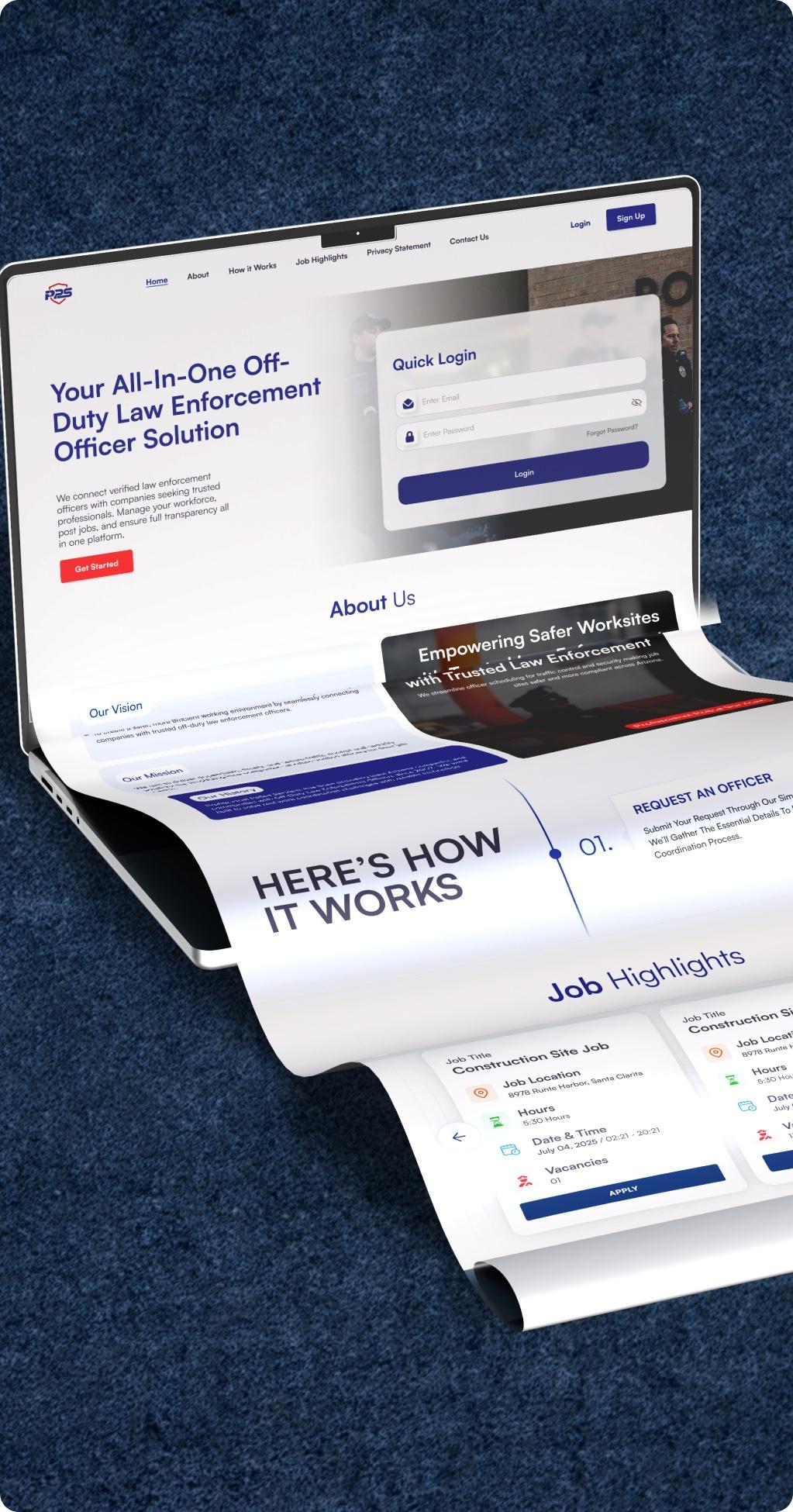
Workforce Management — Security Staffing Operations
A workforce management platform for a security staffing operation, coordinating guard assignments and job orders across sites.

Workforce Management — Recruitment & Applicant Tracking
A hiring and job management platform connecting candidates, HR teams, and interviewers through one structured workflow.
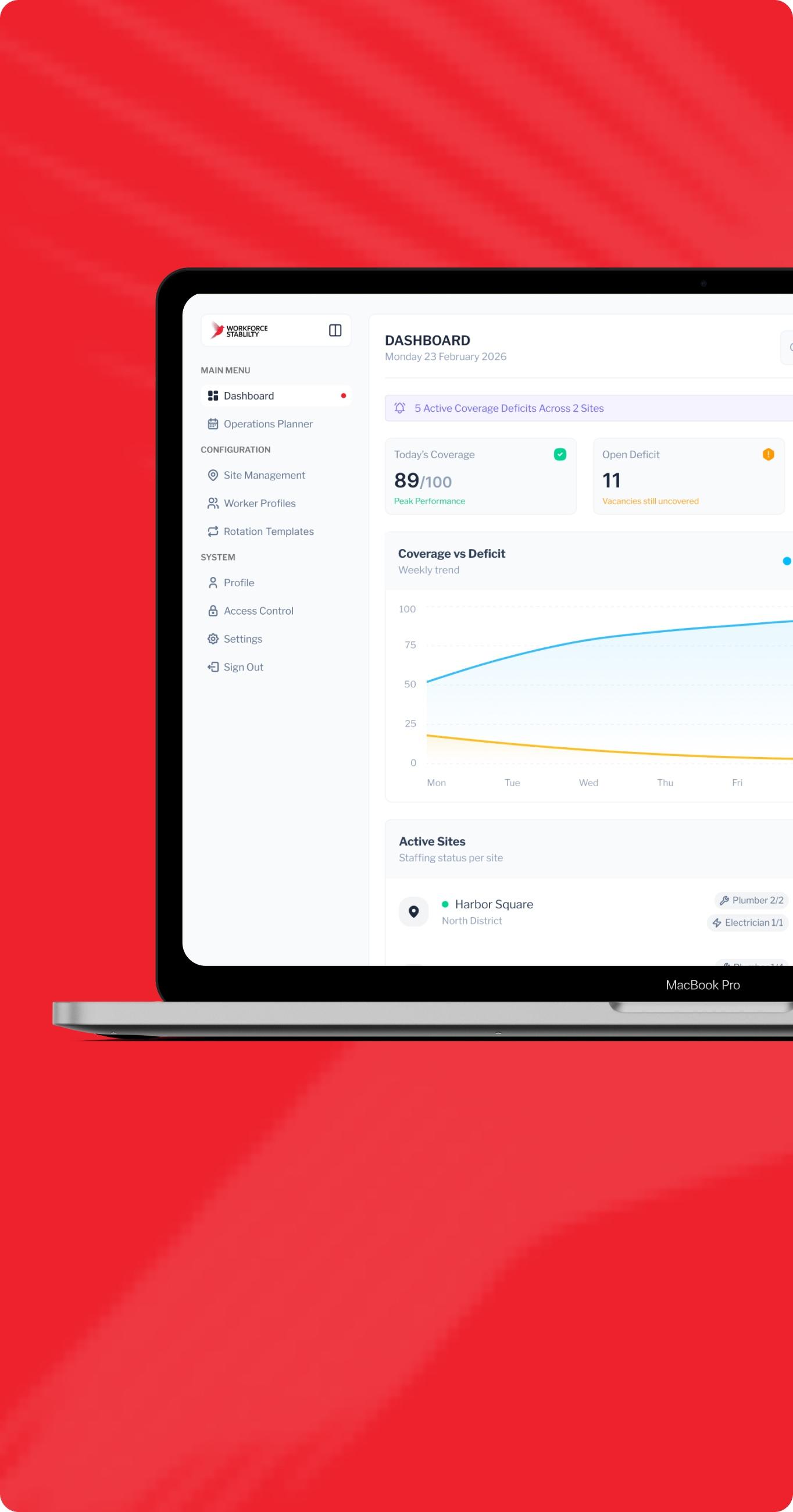
Workforce Management — Shift Scheduling Platform
A workforce management platform helping staffing companies run rotational shift schedules across multiple sites.
Multi-site shift scheduling
Scheduling that accounts for skills, coverage, and labor cost across every site at once.
Geofenced time & attendance
Clock-ins verified by location, replacing an honor-system timesheet with something trustworthy.
Compliance onboarding gates
Right-to-work checks and certification tracking built into onboarding, not chased down after the fact.
Overtime & premium pay rules
Pay-rule logic calculated automatically across split shifts, sites, and time zones.
Timesheet-to-invoice flow
Approved hours flow directly into invoicing, so the two never have to be manually reconciled.
Payroll & HR integrations
Connections into the payroll and HR systems you already run, without duplicate data entry.
AI is not a feature we bolt onto an existing workflow.
It's part of how DevExcel designs, reasons through, automates, monitors, and improves industry software.
AI-assisted scheduling
Demand and availability data becomes a proposed rota that respects skills, coverage and labor cost, put in front of a scheduler to approve or change instead of assembled by hand in a spreadsheet.
Anomaly detection on timesheets
Unusual clock-in patterns and buddy-punching are flagged for review before payroll runs, not discovered after the fact.
Compliance risk alerts
Expiring documents and certifications are surfaced ahead of time, before they quietly become a liability.
Operations leaders managing distributed teams
Leaders running shift-based teams across multiple sites and time zones where scheduling conflicts cost real operational time.
Workforce software founders
Founders building a workforce management SaaS product who need a real scheduling and compliance engine at the core.
HR / payroll operations teams
Teams reconciling timesheets, invoices, and payroll by hand across a distributed or contractor-heavy workforce.
Clock-ins are verified against the worker's actual location at the assigned site, which replaces an honor-system timesheet with something the team can actually trust.
Yes. Pay-rule logic is built around your specific overtime and premium-pay rules and applied automatically across split shifts, multiple sites, and time zones.
Yes. Right-to-work checks and certification expiry are built into onboarding and ongoing compliance gates, with alerts before something lapses rather than after.
Yes. Approved hours flow directly into the invoicing and payroll layer, so the two never have to be reconciled by hand after the fact.
Unusual clock-in patterns are flagged for a human to review before payroll runs, catching likely anomalies without needing someone to manually audit every timesheet.
Yes. We build integrations into the payroll and HR systems you already run rather than requiring a full platform switch.
Don't see your question? Let's talk.
Building in Workforce Management?
Let's talk about your project.
30 minutes. We'll discuss your specific challenge, show relevant work, and tell you honestly what we'd build.