Agents That Plan, Act, and Finish the Job.
AI agents that complete multi-step work, use tools, reason through changing conditions, and operate within explicit permissions and guardrails.
Autonomous agents completing multi-step tasks within defined permissions, with human escalation built in.
What Is Agentic AI?
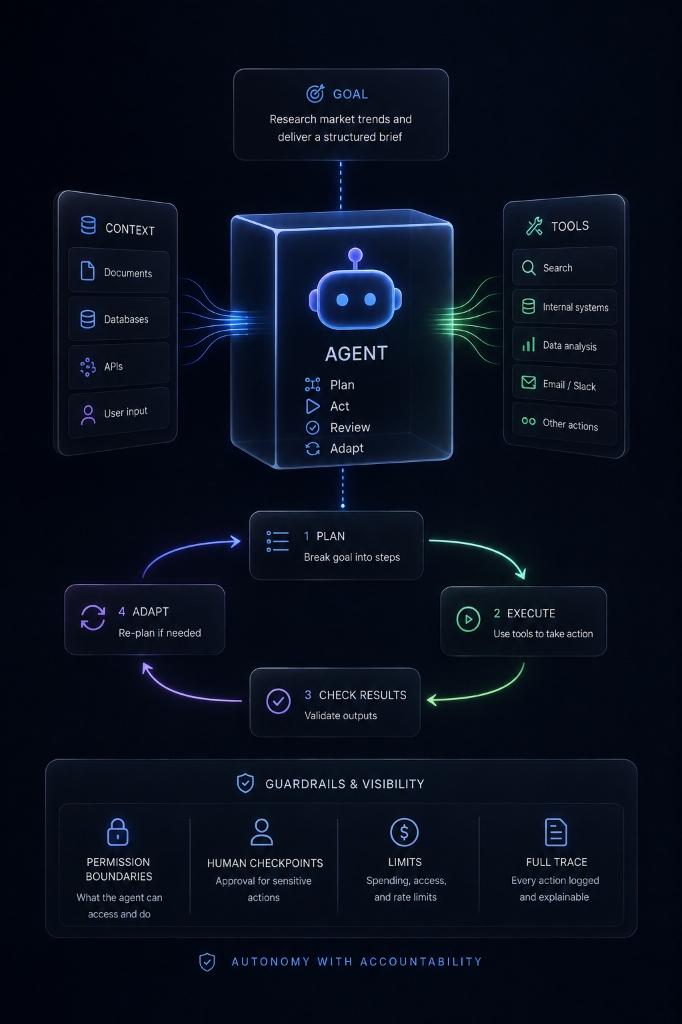
A chatbot answers a question. An agent finishes a task. Agentic AI systems are given a goal, a set of tools, and permission boundaries; then they plan a sequence of steps, execute them, check their own results, and adapt when conditions change mid-task.
That looks like an agent that researches a topic across a dozen sources and produces a structured brief, one that reconciles data across three internal systems and flags discrepancies, or one that handles a support ticket end-to-end, reading context, taking action in your systems, and only escalating what genuinely needs a human. Deciding what counts as "genuinely" is the job of an AI Escalation Engineer, and it is a design decision made before launch rather than a threshold tuned after complaints arrive.
The difference from scripted automation is adaptation: an agent re-plans when a step fails or a tool returns something unexpected, instead of halting the whole workflow. The difference from a chat assistant is that it acts, using real tools and real permissions, not just generating text.
We build these with explicit checkpoints (actions that require approval, spending or access limits, and a full trace of what the agent did and why), so autonomy never means losing visibility into what's actually running in production.
AI moves from answering questions to completing work.
Goals, Not Scripts
Agents are given an objective and the tools to pursue it, so they handle variation and edge cases a fixed script would simply fail on.
Tools in the Agent's Hands
With real API access and real system actions, the agent doesn't just describe what should happen, it does it, inside permissions you define.
Guardrails and Permissions
Every action the agent can take is explicitly scoped, with approval checkpoints on anything irreversible or high-stakes.
Observable by Design
Every plan, tool call, and decision is logged and traceable, so you can audit exactly what an agent did on any given run.
How fast DevExcel delivers this
Reachable when the workflow is already mapped, the tools the agent needs expose usable APIs, and the permission model is agreed before the build starts.
What holds the timeline
- AI-assisted architectureOptions modelled and stress-tested in hours, decided by engineers.
- Automated test generationCoverage lands with the code rather than trailing a release.
- Continuous code reviewReview runs alongside the build, so defects surface early.
Typical delivery runs 6–10 weeks. Guardrails, permissions and the trace layer are designed alongside the agent rather than added afterwards, which is what keeps an autonomous system shippable in that window instead of stuck in review.
Neither bar is a quote. The accelerated path assumes the conditions above hold from day one — scope that grows mid-build, integrations that turn out to be undocumented, or decisions and access that take weeks to come back will move an engagement toward the typical window or past it. We estimate against your actual scope on the discovery call.
Need a timeline for your scope?
Let's Talk Business→Technical Deliverables
A deployed agent with defined goals, planning logic, and self-checking built in, rather than a prototype demo.
Direct connections into the systems the agent needs to act on, scoped to exactly the access it requires.
Explicit approval checkpoints, spend and action limits, and rollback paths for anything the agent shouldn't do unsupervised.
A full run-by-run record of what the agent planned, called, and decided, for every task it completes.
Process Deliverables
We break down the multi-step process the agent needs to own, and identify exactly which steps need a human checkpoint.
Fixed scope covering the agent's goals, tool access, and guardrails, agreed before build starts.
Each planning and execution capability is demoed against real tasks as it's built, not saved for a final reveal.
Your team learns how to read the trace dashboard, adjust guardrails, and extend the agent's tool access safely.
Every engagement is scoped to your project. These are typical deliverables, confirmed in the discovery call.
Want this scoped for your project?
Let's Talk Business→Ops Lead with a Process Spanning Six Tools
The workflow genuinely requires jumping between a CRM, a spreadsheet, an internal API, and email just to close one task.
Founder Who Wants a Real AI Product
The pitch depends on the product actually doing work autonomously, not summarizing text and calling it AI.
CTO Burned by Brittle Automation
A previous automation project broke the moment reality diverged from the happy path it was scripted for.
Sound Familiar?
Let's Talk Business→Discovery Call
We map the multi-step process you want an agent to own, and where human judgment has to stay in control.
Proposal & Scoping
A fixed-scope plan defining the agent's goals, tool access, guardrails, and the specific tasks it will complete end-to-end.
Build
The agent's planning, tool use, and self-checking logic are built and tested against real task scenarios in short increments.
Delivery
Production deployment with guardrails, approval checkpoints, and the trace dashboard live from day one.
Support
Ongoing monitoring of agent runs, plus tuning as your tools, permissions, or task scope evolve.
Most projects complete Steps 1–4 in 6–10 weeks.
The Stack We Build This On.
Ready to Talk About Agentic AI?
Tell us about your project on a discovery call, and we'll help you scope the right approach, honestly.